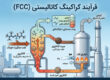
The oil industry is one of the most important sectors of the global energy chain, and its sustainable operation requires a wide range of specialized equipment, facilities, and technologies. The construction of oil infrastructure is not limited to the development of oil extraction facilities; rather, it encompasses a broad range of activities and equipment covering the stages from exploration and initial production to transportation, storage, refining, and export.
Importance of Export Infrastructure
Proper infrastructure ensures that crude oil and petroleum products can be transported and processed with greater safety and efficiency. In addition, the proper design and implementation of such infrastructure can reduce resource losses, operating costs, and potential risks. .
For this reason, the construction of oil infrastructure is considered one of the key components of energy industry development and the expansion of oil production and export capacity.
What Does Oil Infrastructure Construction Include?
Oil infrastructure consists of various components, each of which has a specific role in the energy production and transportation chain.The interconnection between these sections is highly important, as a disruption in any part can also affect the performance of other stages in the chain. Therefore, in oil infrastructure construction projects, coordination between different equipment and facilities must be considered from the early stages of design. The most important of these sections include:
- Oil Field Facilities and Equipment
- Crude Oil Extraction and Production Equipment
- Transportation Pipelines
- Pressure Boosting and Control Stations
- Storage Facilities
- Export Terminals and Ports
- Process Control and Management Equipment
- Refineries
Storage and Terminals in the Oil Industry Infrastructure
Standard storage tanks and well-equipped export terminals play a crucial role in maintaining product quality and facilitating safe and efficient loading operations. Proper safety and storage condition control prevents quality degradation.

Modern Technologies in Oil Infrastructure
Advances in technology have led to the adoption of new methods for designing, constructing, and managing oil infrastructure. Today, digital solutions and smart systems can play an important role in improving the safety and efficiency of facilities. .
One of these technologies is online pipeline monitoring systems, which enable continuous monitoring of the condition of transmission pipelines. The use of inspection robots can also help identify problems and assess the condition of equipment. .
Remote control technologies and digital process management systems also help operators receive information about equipment performance more quickly and take the necessary actions when a problem is detected.
The use of these technologies in oil infrastructure construction can help reduce operating costs, improve safety, and mitigate certain environmental impacts.
The Role of Safety in Oil Infrastructure Construction
Safety is one of the most important principles in the design and implementation of oil projects. Working with crude oil and petroleum products requires strict compliance with safety requirements due to the nature of the materials and equipment involved. .
During the construction of oil infrastructure, risk management, equipment quality control, workforce training, and compliance with safety standards must be considered throughout all stages of the project..
Proper equipment design and the use of monitoring and control systems can also help identify hazards more quickly and reduce the likelihood of accidents.
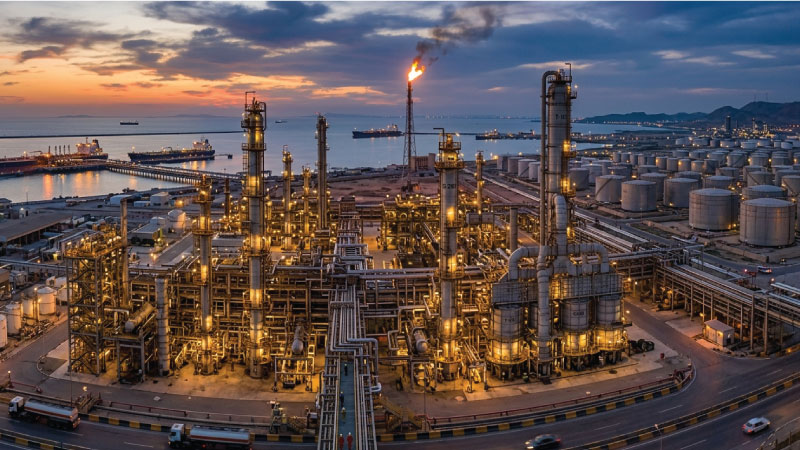
Storage and Terminals in the Oil Industry Infrastructure
The development of the oil industry should go hand in hand with environmental protection. Oil spills, pollutant emissions, and waste generation are among the issues that must be properly managed during the design and implementation of oil projects. The use of leak-prevention technologies, monitoring systems, waste management, and pollutant control can help reduce the environmental impacts of projects. Therefore, in oil infrastructure construction projects, environmental requirements must be considered from the design stage through operation.
Conclusion
The construction of oil infrastructure is one of the main foundations of energy industry development and includes a range of activities such as establishing production facilities, transmission pipelines, storage tanks, refineries, and export terminals.
Accurate engineering design, the use of appropriate equipment, compliance with safety principles, quality control, and the adoption of modern technologies play an important role in improving the durability and efficiency of this infrastructure. On the other hand, environmental protection and proper resource management are also integral parts of oil projects. .
Ultimately, the development of oil infrastructure can contribute not only to increasing energy production and transmission capacity but also to job creation, economic growth, strengthening energy security, and expanding export capacity.
If you are interested in petroleum products and would like to submit an LOI, please contact us.