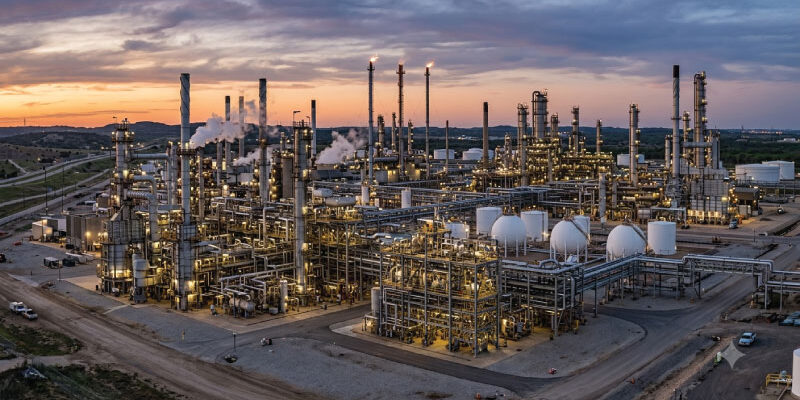
Oil refinery units are a collection of specialized and interconnected sections, each of which plays a specific role in converting crude oil into valuable products. Using units such as atmospheric distillation, vacuum distillation, cracking, hydrotreating, reforming, isomerization, and sulfur recovery, an oil refinery converts crude oil into products such as gasoline, diesel, kerosene, jet fuel, liquefied petroleum gas (LPG), and bitumen.
Each oil refinery unit has a specific function, and the product produced in one section is usually used as feedstock for the next unit. Therefore, the proper operation of these units plays an important role in improving product quality and increasing the efficiency of the crude oil refining process.
Atmospheric Distillation Unit: The Heart of the Refinery
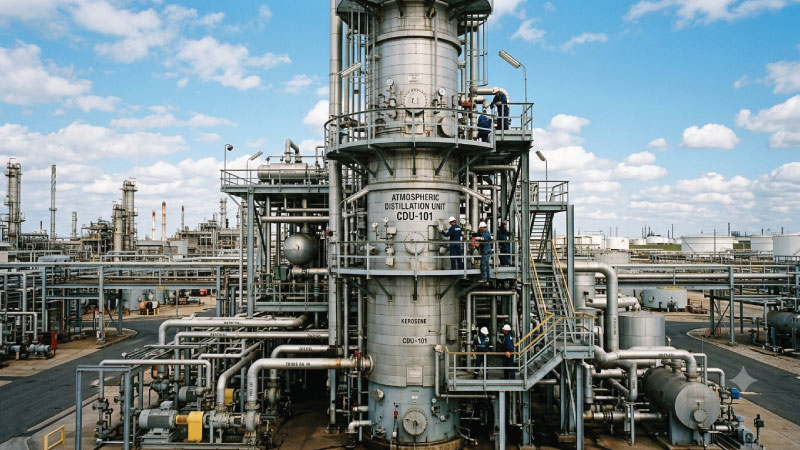
The atmospheric distillation unit is one of the most important units in an oil refinery and the first major stage of crude oil processing. In this unit, crude oil is heated and then fed into a distillation column, where its various components are separated based on differences in their boiling points.
This process produces products such as liquefied petroleum gas (LPG), naphtha, kerosene, diesel, and fuel oil. Many of the refinery’s downstream units receive their required feedstock from the products obtained through atmospheric distillation; therefore, this unit plays an important role in the crude oil processing chain.
Vacuum Distillation Unit
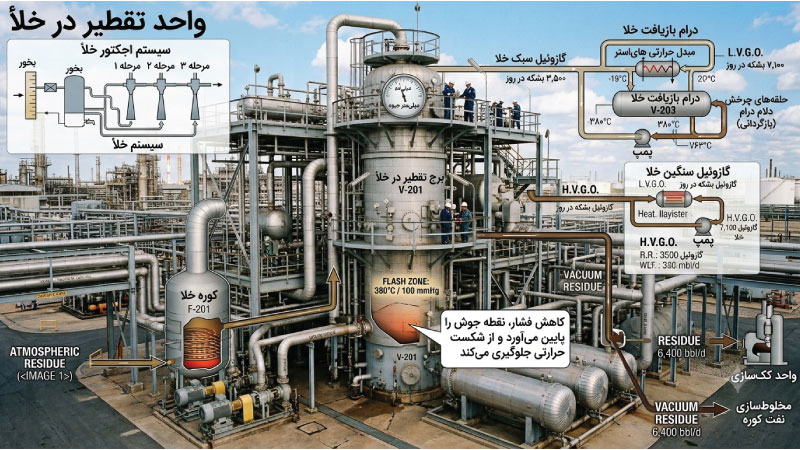
The heavy residue from the atmospheric distillation column still contains valuable compounds that cannot be easily separated at normal pressure. These materials are fed into the vacuum distillation unit, where they are separated into different fractions at lower pressure without causing thermal decomposition.
Key products of this unit include vacuum gas oil, base oils, and vacuum residue (vacuum bottom). These products are used in the production of bitumen, industrial oils, and as feedstock for certain conversion units.
Cracking Unit
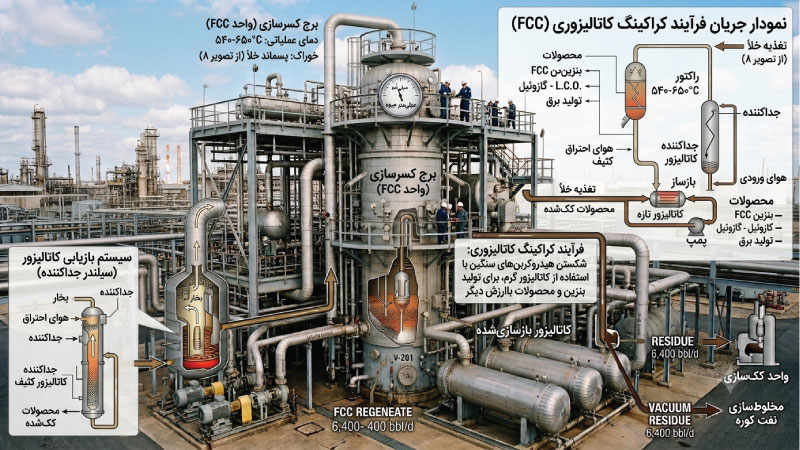
Another important section of oil refinery units is the cracking unit. In this process, heavy hydrocarbon molecules are converted into lighter and more valuable compounds. The main objective of cracking is to increase the production of lighter products such as gasoline and diesel.
Today, many refineries use catalytic cracking, or FCC (Fluid Catalytic Cracking). Compared with some traditional methods, this process enables the production of higher-value products with greater yields.
Hydrotreating Unit
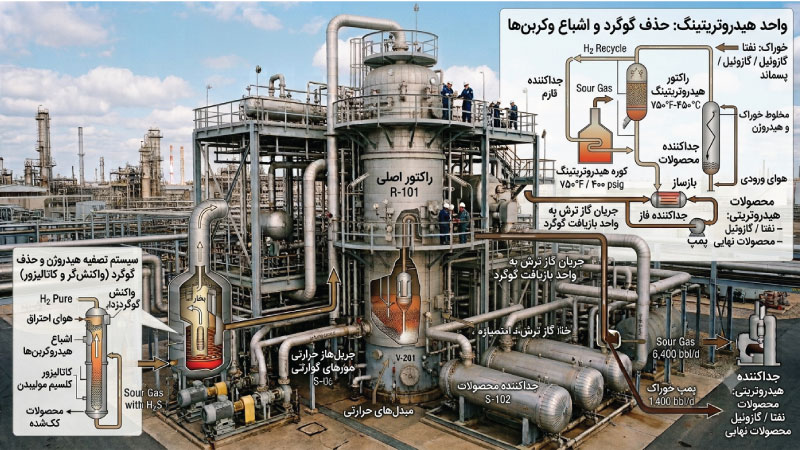
Petroleum products typically contain compounds such as sulfur, nitrogen, and other impurities that can increase environmental pollution or cause damage to equipment. In the hydrotreating unit, these compounds are removed or reduced using hydrogen and a catalyst.
The output products of the hydrotreating unit have higher quality and are better suited to meeting modern environmental requirements. For this reason, this unit is considered one of the key sections in the processing and upgrading of petroleum products.
Catalytic Reforming Unit
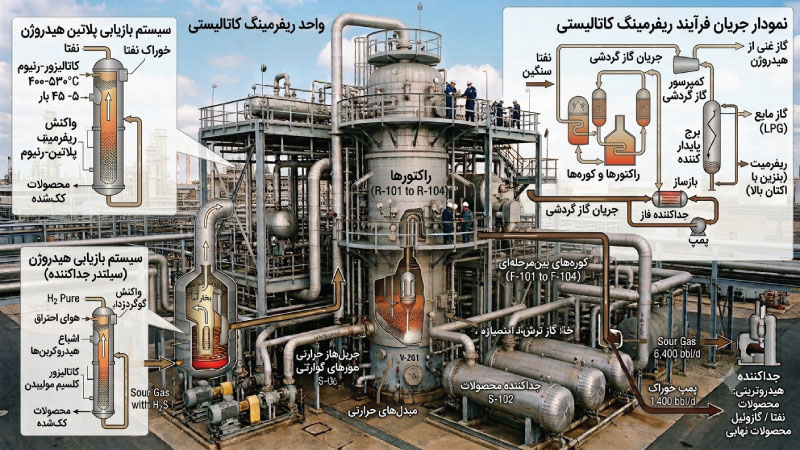
The catalytic reforming unit is responsible for improving naphtha quality and producing compounds used to manufacture higher-octane gasoline. In this process, the structure of hydrocarbon molecules is modified, producing compounds that can improve fuel performance in gasoline engines.
Another important benefit of catalytic reforming is hydrogen production. The hydrogen produced can be used in other units of the oil refinery, particularly the hydrotreating unit.
Isomerization Unit
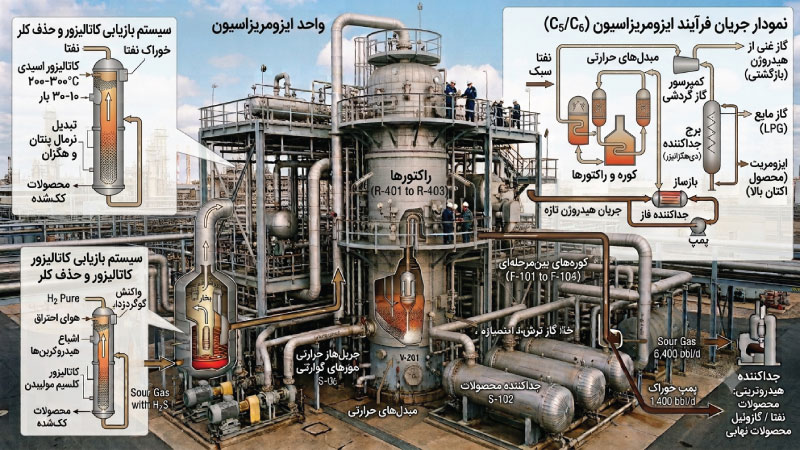
In the isomerization unit, hydrocarbon molecules undergo structural rearrangement without any change in the number of atoms. This structural change can increase the octane number and improve fuel quality.
Isomerization is one of the key processes in modern refineries and contributes to the production of high-quality gasoline.
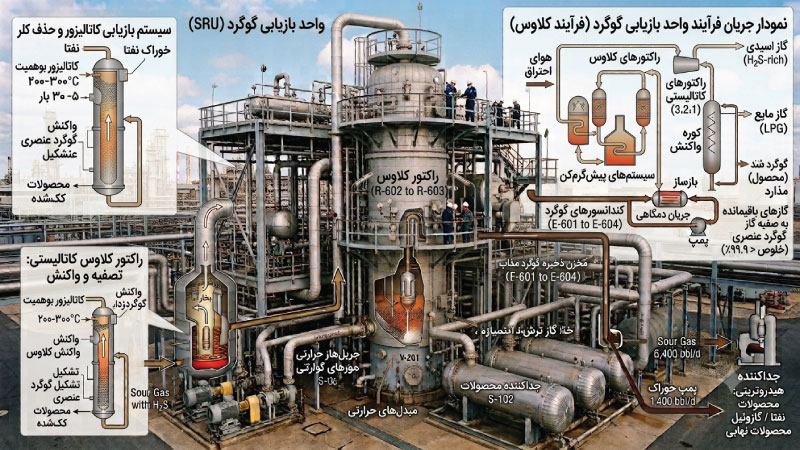
Sulfur Recovery Unit
During the oil refining process, a significant amount of sulfur is removed from crude oil and various refinery streams. The release of sulfur compounds into the environment can cause pollution; therefore, their management and recovery are of great importance.
In the sulfur recovery unit, sulfur present in refinery streams is collected and converted into industrial sulfur. The recovered sulfur is used in industries such as chemical fertilizer production, sulfuric acid manufacturing, and various industrial applications.
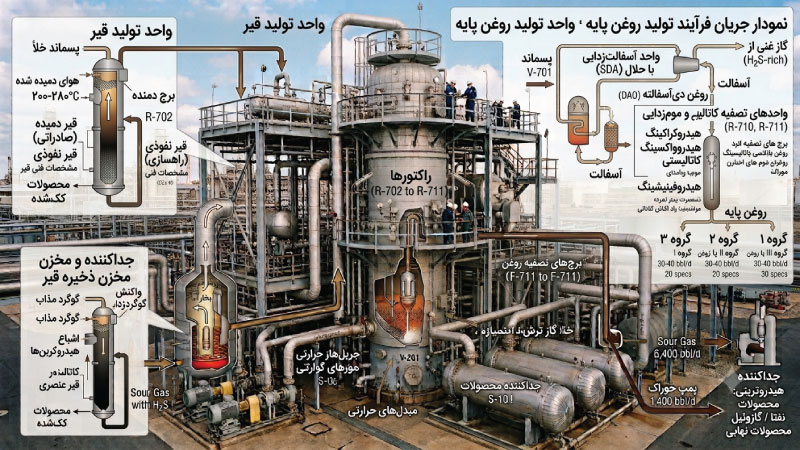
Bitumen and Base Oil Production Unit
Some refineries have dedicated units for the production of bitumen and base oils. In the bitumen production unit, vacuum residue is converted into various grades of paving and industrial bitumen. In the base oil production unit, oil fractions are processed and used as feedstock for the production of lubricants and engine oils.
The presence of these units alongside other refinery units can increase the refinery’s added value and diversify its range of products.
Conclusion
Oil refinery units are a collection of specialized processes that work together to convert crude oil into various usable products. Units such as atmospheric distillation, Vacuum Distillation Cracking Hydrotreating Catalytic Reforming Isomerization Sulfur recovery and bitumen production are important parts of this processing chain.
Understanding the operation of oil refinery units shows that crude oil processing is not limited to a single process, but rather involves a series of interconnected technologies and operations that ultimately enable the production of fuels and products required by various industries.